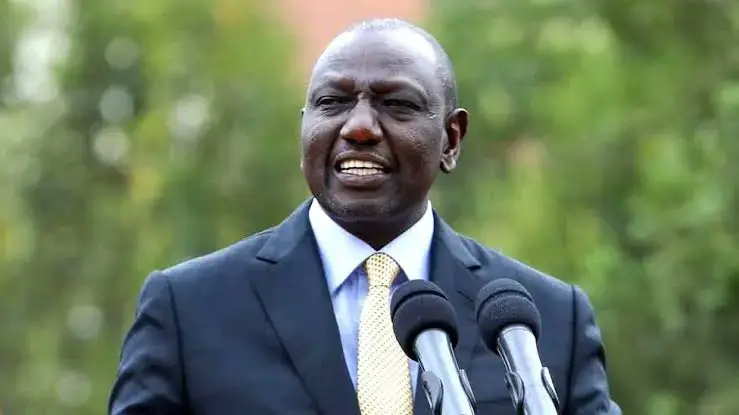
Kenyan President Dr. William Ruto has declared a period of national mourning from October 15, 2025, until sunset on the day of Raila Odinga’s interment, following the passing of the former Prime Minister.
In a proclamation issued from State House, Nairobi, President Ruto directed that the national flag and that of the East African Community be flown at half-mast across the Republic and at all Kenyan missions abroad. He further announced that the late Odinga would be accorded a state funeral, complete with full military honors, in recognition of his monumental contribution to the nation’s political evolution.
Born on January 7, 1945, in Maseno, Kisumu County, Raila Amolo Odinga passed away at the age of 80 while receiving medical treatment in India. The ailment for which he had sought treatment has not yet been disclosed by his family.
President Ruto mourned his long-time political rival and compatriot, describing him as “a man who dedicated his entire adult life to the service of Kenya.” He paid glowing tribute to Odinga, calling him “the father of Kenya’s democracy, a tireless champion for social justice, and a renowned Pan-Africanist who played a defining role in shaping Kenya’s modern political history.”
Ruto emphasized that despite their fierce political rivalry, Odinga’s commitment to advancing democracy, freedom, and the rights of ordinary citizens remained unwavering. “Kenya has lost one of its most distinguished sons — a patriot whose courage and conviction left an indelible mark on our nation’s journey toward unity and progress,” Ruto stated.
Odinga, son of Kenya’s first Vice President Jaramogi Oginga Odinga, emerged as a central figure in Kenya’s struggle for multiparty democracy in the late 1980s and early 1990s. His years of detention without trial under the Moi regime made him a symbol of resistance and resilience.
A trained engineer turned politician, Raila’s entry into politics was driven by his passion for reform and equity. He played a pivotal role in the formation of the National Rainbow Coalition (NARC) that brought Mwai Kibaki to power in 2002, ending four decades of KANU’s rule.
Odinga later served as Kenya’s Prime Minister from 2008 to 2013 in the Grand Coalition Government formed after the disputed 2007 elections. His tenure was marked by efforts to heal the nation, advance constitutional reforms, and promote national reconciliation.
Over the decades, Raila became synonymous with Kenya’s reform agenda — advocating for devolution, electoral justice, and good governance. His leadership of the Orange Democratic Movement (ODM) cemented his status as one of the country’s most influential political figures.
On the continental stage, Odinga championed the ideals of Pan-Africanism and regional integration. He most recently served as the African Union’s High Representative for Infrastructure Development, where he worked to promote connectivity across Africa through transport and energy projects.
Tributes have continued to pour in from across the continent and beyond. Leaders from the African Union, the East African Community, and various global institutions have hailed Odinga’s legacy as one that transcended Kenya’s borders.
Plans for his state funeral are underway, with a special national committee expected to announce details regarding the memorial service, lying-in-state, and burial program in the coming days.
As the nation mourns, Kenyans from all walks of life have gathered in public squares, homes, and churches to honor a man whose name became synonymous with struggle, reform, and hope.